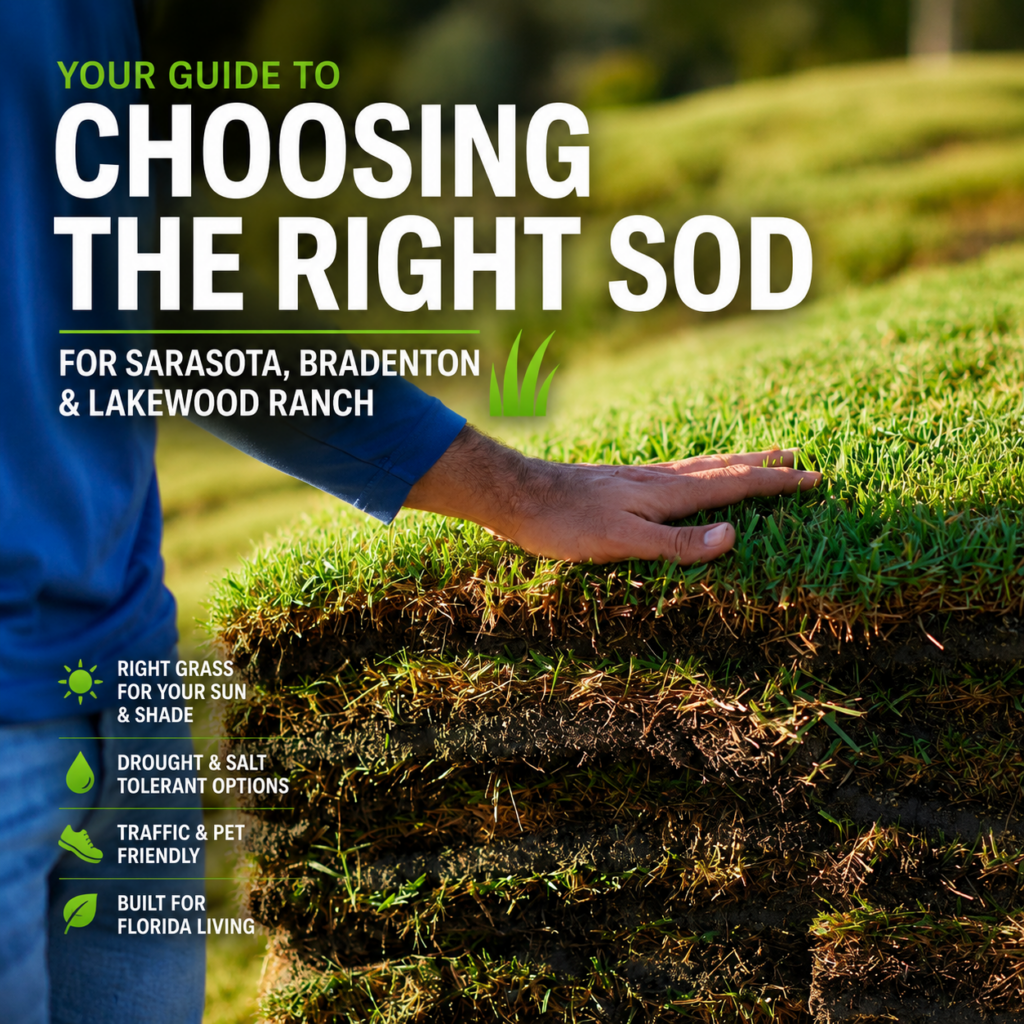
What this guide is: a complete, plain-English walkthrough of every sod variety grown and sold by Bayside Sod — Floratam, ProVista, and Bitter Blue St. Augustine, Empire Zoysia, Bimini Bermuda, and Bahia — with the sunlight, irrigation, traffic, and maintenance facts you need to pick the right one the first time.
Who it’s for: homeowners and landscapers across Sarasota, Bradenton, Lakewood Ranch, and the surrounding Gulf Coast communities who are installing a new lawn, replacing tired turf, or upgrading to a premium variety.
How to use it: start with the growing-environment overview, then jump straight to the grass varieties that fit your yard using the quick links below. The side-by-side comparison chart and five-step decision framework will narrow your choice, and the installation tips and year-round care calendar will keep your new lawn thriving. When you’re ready, request a quote and we’ll cut it fresh from our farm.
Or call (941) 702-1746 — We Grow. We Install. We Guarantee.
 DOWNLOAD THE GUIDE – CLICK HERE
Quick Links: Jump to What You Need
- Introduction: Why Choosing the Right Sod Matters in Florida
- Understanding Florida’s Growing Environment
- Floratam St. Augustine: Florida’s Most Popular Lawn Grass
- ProVista St. Augustine: The Low-Maintenance Upgrade
- Bitter Blue St. Augustine: The Shade Champion
- Empire Zoysia: Premium Beauty with Built-In Resilience
- Bimini Bermuda: Athletic-Grade Durability for High-Traffic Lawns
- Bahia Grass: The Budget-Friendly, Low-Maintenance Option
- Side-by-Side Sod Comparison Chart
- How to Choose the Right Sod for Your Property
- Sod Installation Tips for Sarasota, Bradenton & Lakewood Ranch
- Year-Round Lawn Care Calendar for Southwest Florida
- Local Considerations: Sarasota vs. Bradenton vs. Lakewood Ranch
- Conclusion: Your Perfect Florida Lawn Starts with the Right Sod
Introduction: Why Choosing the Right Sod Matters in Florida
Florida’s unique climate presents both opportunities and challenges for homeowners who want a lush, green lawn. With year-round warmth, high humidity, seasonal downpours, and sandy soils that are characteristic of the Gulf Coast region, the grass variety you choose can make or break your landscape investment. Whether you are searching for a guide to sod for Sarasota, a comprehensive guide to sod for Bradenton, or a practical guide to sod for Lakewood Ranch, this article will walk you through every sod variety available from Bayside Sod and help you make a confident, informed decision.
Selecting sod is not simply about picking a shade of green. Each grass variety has distinct characteristics—blade texture, sunlight requirements, drought tolerance, irrigation needs, traffic resilience, and maintenance demands—that determine how well it will perform on your specific property. A lawn that thrives in a sun-drenched front yard in Lakewood Ranch may struggle in a shaded backyard in Sarasota, and vice versa. Understanding these differences upfront saves you time, money, and frustration down the road.
Bayside Sod, located at 19810 SR 64 E, in Bradenton, has earned recognition on the Inc. 5000 list of America’s fastest-growing companies and is known for outstanding customer service. Every variety is cut fresh daily and backed by a quality guarantee: if you’re not satisfied with the quality upon arrival, they’ll replace it or refund your money. That level of commitment gives Florida homeowners the confidence to invest in the right sod from the start.
Understanding Florida’s Growing Environment
Before diving into individual grass varieties, it helps to understand the environmental factors that shape lawn success across the Sarasota, Bradenton, and Lakewood Ranch corridor. This region sits firmly within USDA Hardiness Zones 9b to 10a, which means warm-season grasses dominate and cold-hardy species are largely unnecessary. The area’s sandy, slightly acidic soils drain quickly—an advantage during the rainy season but a challenge during dry spells when turf needs consistent moisture.
Key Climate Factors for Gulf Coast Lawns
-
Average summer temperatures regularly exceed 90°F with humidity above 70%, creating prime growing conditions for warm-season turfgrasses.
-
The rainy season (June through September) delivers heavy afternoon thunderstorms that can saturate lawns, increasing the risk of fungal diseases like gray leaf spot.
-
Winter temperatures occasionally dip into the low 30s, upper 20s, which can cause some varieties to go dormant and brown temporarily.
-
Salt spray exposure along coastal Sarasota and Bradenton neighborhoods affects grass health, making salt tolerance an important factor for waterfront properties.
-
Sandy soils drain fast, meaning irrigation systems are essential for most varieties to maintain consistent moisture levels year-round.
With these factors in mind, let’s explore each sod variety available from Bayside Sod and identify which one best matches your property’s specific conditions.
Floratam St. Augustine: Florida’s Most Popular Lawn Grass
When most Floridians picture a beautiful lawn, they’re envisioning Floratam St. Augustine. Originally developed in a partnership between the University of Florida and Texas A&M University and released in 1973, Floratam has become the most widely planted turfgrass variety across the state. It remains the go-to recommendation in any guide to sod for Sarasota or guide to sod for Bradenton for homeowners with sunny, open yards.
What Makes Floratam Stand Out
Floratam is defined by its broad, coarse-textured blades that create a thick, cushiony lawn with a deep green to bluish-green color during the growing season. It spreads aggressively through horizontal stolons—above-ground stems that creep along the soil surface and generate new roots and shoots at each node. This growth habit allows Floratam to fill in bare patches and repair minor damage relatively quickly, which is a significant advantage for active households.
The grass thrives in full sun, requiring a minimum of six to eight hours of direct sunlight daily for optimal performance. It handles Florida’s intense summer heat with ease and demonstrates moderate salt tolerance, making it a workable option for coastal properties in Sarasota and the barrier islands. Floratam also resists the St. Augustine Decline (SAD) virus, a destructive pathogen that can devastate other cultivars.
Ideal Use Cases
-
Sun-drenched front yards and open landscapes with minimal tree canopy throughout Sarasota, Bradenton, and Lakewood Ranch.
-
Homeowners seeking a classic, lush Florida lawn appearance at an affordable price point.
-
Properties where HOA timelines demand fast visual coverage, since Floratam’s aggressive spread fills seams and bare areas faster than many other cultivars.
-
Yards with moderate foot traffic from children, pets, and general outdoor living.
Important Considerations
Floratam does have limitations worth noting. Its shade tolerance is poor—areas receiving less than six hours of direct sun will thin noticeably over time. It requires permanent irrigation to stay healthy and green, and during periods of drought, it will go dormant and brown without supplemental watering. It was originally bred for chinch bug resistance, but over the decades, chinch bug populations have adapted, meaning regular pest monitoring is still necessary. Floratam also does not produce viable seeds, so all establishment must be done through sod, plugs, or sprigs. Mowing should maintain a height of three to four inches, and weekly mowing during the peak growing season is typical.
For the sunny front and side yards throughout Lakewood Ranch’s master-planned communities, Floratam remains a proven workhorse that delivers reliable curb appeal year after year.
ProVista St. Augustine: The Low-Maintenance Upgrade
If Floratam is the classic Florida lawn, then ProVista is its modern evolution. Developed by Scotts and bred from Floratam genetics, ProVista combines the familiar appearance of traditional St. Augustine with breakthrough features that dramatically reduce maintenance demands. For anyone reading this guide to sod for Lakewood Ranch who values their weekends, ProVista deserves serious consideration.
The ProVista Advantage
ProVista’s most notable feature is its tolerance to glyphosate-based herbicides, making it the first turfgrass on the market with this capability. This means homeowners can spray products containing glyphosate (such as Roundup) directly over the lawn to eliminate invasive weeds—including notoriously difficult species like torpedo grass and Bermuda grass—without harming the turf itself. For anyone who has battled persistent weed infestations in their St. Augustine lawn, this is a genuine game-changer.
Beyond weed control, ProVista grows approximately 40 to 50 percent slower vertically than standard Floratam. That slower upward growth translates directly into less frequent mowing—roughly half the mowing schedule of a traditional St. Augustine lawn. The grass channels its energy into horizontal, lateral spread instead, creating a dense canopy that further suppresses weed establishment naturally.
Shade and Sun Performance
ProVista offers improved shade tolerance compared to Floratam. It can thrive with as little as four hours of direct sunlight daily and adapts well to yards where buildings, fences, or mature trees create partial shade conditions. It also performs strongly in full sun, making it one of the most versatile St. Augustine varieties available. The deeper, darker green color is a visual bonus that many homeowners appreciate—it creates an especially rich, manicured appearance even between mowing cycles.
Ideal Use Cases
-
Homeowners who want a beautiful St. Augustine lawn with significantly reduced mowing and maintenance effort.
-
Properties with persistent weed problems, especially Bermuda grass or torpedo grass invasions.
-
Yards with mixed sun and shade conditions where standard Floratam thins out.
-
Busy professionals and families across Sarasota, Bradenton, and Lakewood Ranch who prefer a low-effort lawn care routine.
Important Considerations
ProVista is typically priced higher than Floratam, reflecting its premium genetics and licensing. Its slower growth rate, while a benefit for mowing frequency, also means it recovers from damage more slowly. If sod is torn up by construction, heavy equipment, or severe pet activity, ProVista will take longer to fill back in compared to Floratam’s aggressive repair habit. Some homeowners have reported that ProVista can be more susceptible to fungal issues like gray leaf spot, particularly during the wet summer months, so proper irrigation management—watering in the morning and avoiding overwatering—is critical. Like all St. Augustine varieties, it requires permanent irrigation and moderate fertilization for best results.
Bitter Blue St. Augustine: The Shade Champion
For homeowners whose yards are defined by mature oak canopies, tall fences, or multi-story structures that block direct sunlight, Bitter Blue St. Augustine is the leading solution. This variety appears in nearly every guide to sod for Sarasota as the top recommendation for shaded landscapes, and for good reason.
Shade Tolerance That Sets It Apart
Bitter Blue is specifically recommended for yards that experience up to 60 percent shade during the day. Unlike Floratam, which struggles and thins dramatically in low-light conditions, Bitter Blue maintains its density and color even when sunlight is limited. It also performs well in full sun, giving it a dual versatility that makes it appropriate for properties with a mix of sunny and shaded zones. The grass features a distinctive dark blue-green color that gives it a refined, elegant appearance—slightly different from the brighter green of Floratam.
Traffic and Pet Tolerance
Bitter Blue holds up well under moderate foot traffic and pet activity, making it a practical choice for families with children and dogs. Its broad, coarse blades are characteristic of the St. Augustine family, and it establishes at a moderate pace. Like other St. Augustine varieties, it requires permanent irrigation and regular fertilization to maintain its health and appearance.
Ideal Use Cases
-
Heavily shaded yards beneath established tree canopies in older Sarasota and Bradenton neighborhoods.
-
Properties with mixed sun and shade where a single grass variety needs to perform in both conditions.
-
Homeowners who appreciate a darker, blue-green aesthetic in their lawn.
-
Yards with moderate daily traffic from pets, children, and outdoor entertaining.
Important Considerations
Bitter Blue shares many of the same maintenance requirements as other St. Augustine cultivars: permanent irrigation, regular mowing at three to four inches, seasonal fertilization, and vigilance against chinch bugs and fungal diseases. Its drought tolerance is moderate, so supplemental watering during dry spells is essential. While it handles shade far better than Floratam, it is not a grass that can survive in deep, all-day shade with zero direct sunlight—some filtered or partial sun is still necessary for healthy growth.
Empire Zoysia: Premium Beauty with Built-In Resilience
Empire Zoysia represents a different approach to Florida lawn care. Unlike the St. Augustine family’s broad, coarse blades, Empire features a fine-to-medium textured, narrow leaf blade that creates an exceptionally dense, carpet-like turf. For homeowners who want their lawn to look and feel like a golf course fairway, Empire Zoysia delivers. It’s a standout recommendation in any guide to sod for Lakewood Ranch, where manicured landscapes are a point of pride.
A Lawn with Multiple Benefits
Empire Zoysia is marketed as delivering “one lawn, many benefits,” and the claim holds up under scrutiny. This revolutionary medium-bladed, dark green turf is easy to maintain, soft underfoot, and visually stunning. It offers excellent wear tolerance, making it resilient under moderate foot traffic from children, pets, and outdoor activities. It requires less frequent mowing and fewer chemical applications than many competing varieties, and it is naturally resistant to chinch bugs—a significant advantage given how damaging these pests can be to St. Augustine lawns.
One of Empire’s most important qualities is its drought behavior. While it requires permanent irrigation for optimal appearance, it has a unique survival mechanism: the water supply can be shut off during severe drought periods without permanently harming the lawn. Empire will go dormant and brown, but unlike some other varieties, it bounces back once water is restored. This resilience provides a safety net during water restrictions or extended dry spells—a common concern addressed in every guide to sod for Bradenton and the surrounding Gulf Coast.
Sun and Shade Flexibility
Empire Zoysia performs well in full sun and tolerates partial shade, giving it broad versatility across different yard configurations. Its fine texture and dense growth habit help it crowd out weeds naturally, reducing the need for herbicide applications. The grass establishes at a moderate to slow pace compared to St. Augustine varieties, so patience during the initial rooting period is important.
Ideal Use Cases
-
Homeowners who prioritize a refined, soft, carpet-like lawn texture over the coarser St. Augustine appearance.
-
Properties in Lakewood Ranch, Sarasota, and Bradenton where water conservation and drought resilience are priorities.
-
Families with active outdoor lifestyles who need a turf that handles wear without looking worn.
-
Landscapes where chinch bug resistance is a deciding factor.
Important Considerations
Empire Zoysia’s establishment time is slower than St. Augustine varieties, so new installations take longer to fill in completely and achieve full density. It requires permanent irrigation for optimal green color, though its drought survival mechanism provides a backup during extreme conditions. Fall and winter large patch control is important. Mowing height should be maintained between one and a half to three inches, and a reel mower can produce the best-quality cut, though a rotary mower with sharp blades also works well. Empire Zoysia is typically priced at a premium compared to standard St. Augustine varieties.
Bimini Bermuda: Athletic-Grade Durability for High-Traffic Lawns
Bimini Bermuda is the sod equivalent of a professional athlete—developed for peak performance under demanding conditions. This improved hybrid Bermuda grass was specifically engineered for athletic applications like golf courses, football fields, baseball diamonds, and soccer pitches. Its soft texture provides a comfortable surface for athletes to land on, but it also creates an exceptionally enjoyable and durable home lawn. For any homeowner reviewing a guide to sod for Sarasota or guide to sod for Bradenton who has a high-traffic yard, Bimini Bermuda is a top contender.
Unmatched Durability
Bimini Bermuda forms a fine-textured, dense turf with a beautiful dark green color and upright leaf growth. It is considered one of the most durable turfgrasses available, handling moderate to heavy foot traffic without thinning or developing bare patches. Its establishment time is moderate to fast—faster than both Zoysia and standard St. Augustine—meaning your lawn reaches full density and usability sooner after installation.
Sun Requirements and Drought Performance
This is a grass that thrives in full sun and demands it—Bimini Bermuda offers excellent performance in direct sunlight but has limited shade tolerance. If your property has significant tree coverage or structures blocking sunlight, Bermuda grass will struggle. However, in open, sun-drenched yards, it excels. Bimini demonstrates good drought resistance and does not strictly require permanent irrigation, though supplemental watering is recommended for maintaining optimal color and density during dry periods.
Ideal Use Cases
-
Homes with large, open, sunny yards that receive heavy daily use from children, pets, and outdoor activities.
-
Properties where a fine-textured, soft, athletic-quality turf is desired over the coarser St. Augustine look.
-
Homeowners who want faster establishment and a turf that fills in quickly after installation.
-
Yards that experience moderate to heavy foot traffic, including pathways, play areas, and entertaining spaces.
Important Considerations
Bimini Bermuda’s limited shade tolerance means it is not appropriate for yards with significant tree canopy or shading structures. It requires moderate maintenance, including regular mowing at a lower height (as low as 3/8” for the high-level) to maintain its fine-textured appearance. Bermuda grass can be aggressive, spreading into garden beds and neighboring yards if not regularly edged. Permanent irrigation is recommended though not strictly required, and it does go dormant during cooler winter months, turning brown until temperatures rise again in spring.
Bahia Grass: The Budget-Friendly, Low-Maintenance Option
Not every lawn needs to be a showpiece. For homeowners who prioritize function, durability, and low cost over manicured aesthetics, Bahia grass is the practical choice. It appears in every guide to sod for Bradenton and the broader Gulf Coast as the go-to variety for utility lawns, large lots, and properties where the budget matters more than visual perfection.
Outstanding Drought and Heat Tolerance
Bahia grass is valued for its exceptional drought and heat tolerance and its ability to thrive where many lawn grasses cannot survive. In the southeastern United States, it produces a relatively durable, low-growing, low-maintenance turf that requires minimal intervention once established. Most importantly, Bahia is the only variety offered by Bayside Sod that does not require a permanent irrigation system. Watering is needed only during the establishment period; after that, the deep root system of Bahia grass allows it to survive on natural rainfall alone.
What to Expect
Bahia grass has medium-width blades with a moderate texture—less coarse than St. Augustine but not as fine as Bermuda. It performs best in full sun with limited shade tolerance. Its maintenance demands are genuinely low: infrequent mowing, minimal fertilization, and no permanent irrigation system. However, it’s important to set realistic expectations about appearance. Bahia sod is harvested from pastures rather than maintained sod farms, and it is common for pieces to contain weeds, break apart during handling, and appear inconsistent at installation. Over a few weeks, the sod will settle, root, and begin to fill in to create a uniform-looking yard.
Ideal Use Cases
-
Large rural or semi-rural properties where aesthetic perfection is less important than coverage and cost efficiency.
-
Utility areas, side yards, back lots, and spaces that do not face public roads or HOA scrutiny.
-
Properties without an irrigation system where the homeowner does not plan to install one.
-
Roadside applications, erosion control, and commercial properties where durability matters most.
-
Budget-conscious homeowners who need functional ground cover across a large area.
Important Considerations
Bahia’s appearance will never match the lush, manicured look of St. Augustine or Zoysia. It tends to produce tall, stemmy seed heads that require periodic mowing to keep the lawn looking tidy. The grass can be used in residential yards, but homeowners in Lakewood Ranch and other HOA-governed communities should check their community’s landscaping guidelines before choosing Bahia, as some HOAs require specific grass varieties that maintain a more polished appearance. Bahia’s quality cannot be guaranteed to the same standard as farm-grown varieties, and buyers should be prepared for initial inconsistencies.
Side-by-Side Sod Comparison Chart
The following comparison chart summarizes the key characteristics of every sod variety available from Bayside Sod. Use this reference to quickly identify which grass best fits your property’s specific conditions across Sarasota, Bradenton, and Lakewood Ranch.
| Characteristic | Floratam | ProVista | Bitter Blue | Empire Zoysia | Bimini Bermuda |
|---|---|---|---|---|---|
| Blade Type | Broad & Coarse | Broad & Coarse | Medium Coarse | Fine to Medium | Fine & Pointed |
| Sun Needs | Full Sun (6-8 hrs) | Full Sun to Part Shade (4+ hrs) | Full Sun to 60% Shade | Full Sun, Limited Shade | Full Sun Required |
| Irrigation | Permanent Required | Permanent Required | Permanent Required | Permanent Required | Recommended |
| Drought Tolerance | Moderate | Moderate | Moderate | Moderate (survives shutoff) | Good |
| Maintenance | Moderate | Lower (50% less mowing) | Moderate | Moderate | Moderate |
| Traffic Tolerance | Moderate | Moderate | Moderate | Moderate | Moderate to Heavy |
| Establishment | Moderate | Moderate | Moderate | Moderate to Slow | Moderate to Fast |
| Weed Control | Standard | Glyphosate Tolerant | Standard | Dense growth crowds weeds | Standard |
| Chinch Bug Resistance | Reduced over time | Similar to Floratam | Similar to Floratam | Resistant | N/A |
| Best For | Sunny open yards | Low-maintenance + weed control | Shaded properties | Premium carpet-like turf | High-traffic athletic use |
Note: Bahia grass is not included in the comparison chart above because its harvesting and quality standards differ from farm-grown varieties. Refer to the Bahia section above for complete details.
How to Choose the Right Sod for Your Property
With six varieties to consider, narrowing down the best choice for your specific property involves evaluating a few critical factors. Walk through these decision points to identify your ideal match.
Step 1: Assess Your Sunlight
Walk your property at different times of day and note which areas receive full sun, partial shade, and heavy shade. If your yard gets six or more hours of direct sunlight, Floratam, ProVista, Empire Zoysia, and Bimini Bermuda are all viable options. If significant portions of your yard sit in shade for much of the day, Bitter Blue and ProVista become your primary choices. Yards with zero direct sun are challenging for any turfgrass variety.
Step 2: Evaluate Your Traffic Patterns
Households with children, dogs, or frequent outdoor entertaining need a grass that handles wear. Bimini Bermuda is the clear winner for heavy traffic. Empire Zoysia, Floratam, ProVista, and Bitter Blue all handle moderate traffic well. For low-traffic areas or utility spaces, Bahia is perfectly adequate.
Step 3: Consider Your Irrigation Setup
If your property does not have a permanent irrigation system and you do not plan to install one, Bahia is your only realistic option. Bimini Bermuda can get by with recommended (but not required) irrigation. All St. Augustine varieties and Empire Zoysia require permanent irrigation for long-term health.
Step 4: Determine Your Maintenance Commitment
Be honest about how much time and effort you want to invest in lawn care. If you prefer minimal mowing and simplified weed control, ProVista’s slower growth rate and glyphosate tolerance make it the standout choice. Bahia is the lowest-maintenance option overall. Empire Zoysia and Bimini Bermuda fall in the moderate range. Floratam and Bitter Blue require regular weekly mowing during the growing season.
Step 5: Set Your Budget
Bahia is the most affordable variety but comes with lower visual standards. Floratam is the most widely available and competitively priced among premium sod options. Bitter Blue, Empire Zoysia, and Bimini Bermuda are priced moderately higher. ProVista commands the highest price point due to its proprietary genetics and licensing. Consider the long-term cost equation as well—a variety that requires less mowing, less water, and fewer chemical treatments may cost more upfront but save money over its lifetime.
Sod Installation Tips for Sarasota, Bradenton & Lakewood Ranch
Regardless of which variety you choose, proper installation practices are critical for long-term success. Fresh sod is a living product, and how you handle the first two weeks after installation largely determines how well your lawn establishes.
-
Prepare your soil. Remove old grass, weeds, and debris. Grade the soil to ensure proper drainage away from your home’s foundation. Loosen the top two to three inches of soil and consider adding a compost amendment like Bayside Sod’s Comand Sod Compost to improve nutrient content and moisture retention in Florida’s sandy soils.
-
Install sod immediately upon delivery. Fresh-cut sod is perishable and should be laid within 24 hours of delivery. Stagger seams like brickwork to prevent visible lines and ensure tight joints between pieces with no gaps or overlaps.
-
Water immediately and consistently. Soak the new sod thoroughly as soon as each section is installed. For the first seven to ten days, apply multiple short irrigation cycles throughout the day to keep the sod consistently moist—but not soggy. After the initial period, transition to once-daily watering for another week, then taper to a regular schedule of two to three times per week.
-
Avoid traffic during establishment. Stay off newly installed sod for at least two weeks to allow root anchoring. Seams can shift easily before roots take hold.
-
First mow at the right time. Wait until the sod has rooted—typically ten to fourteen days in warm weather—before mowing. Set your mower to the recommended height for your variety and never remove more than one-third of the blade length in a single mowing.
-
Fertilize after establishment. Wait approximately 20 to 30 days after installation before applying fertilizer. Fresh sod from the farm typically contains sufficient nutrients to sustain initial growth.
Bayside Sod also offers professional installation services for homeowners who prefer a hands-off approach. Call (941) 702-1746 to discuss installation options and scheduling.
Local Considerations: Sarasota vs. Bradenton vs. Lakewood Ranch
While all three communities share the same general climate, subtle differences in landscape character can influence your sod selection.
Sarasota
Sarasota’s coastal neighborhoods experience increased salt spray exposure, making salt-tolerant varieties like Floratam and Empire Zoysia particularly well-suited. Older neighborhoods often feature mature tree canopies that create significant shade, pushing homeowners toward Bitter Blue or ProVista. The city’s emphasis on landscaping aesthetics makes the premium appearance of Empire Zoysia and ProVista attractive choices for properties where curb appeal is a priority. Homeowners seeking a comprehensive guide to sod for Sarasota should prioritize salt tolerance and shade assessment.
Bradenton
Bradenton offers a mix of established residential neighborhoods and newer developments. Properties closer to the coast share Sarasota’s salt exposure concerns, while inland areas have more flexibility. Bradenton’s growing suburban developments often feature open, sunny lots that are ideal for Floratam or Bimini Bermuda. For anyone reviewing a guide to sod for Bradenton, assessing your specific lot’s sun exposure and proximity to the coast is the first decision point.
Lakewood Ranch
As a master-planned community, Lakewood Ranch features a wide range of lot sizes and landscape designs, many governed by HOA standards. The community’s well-maintained aesthetic means many homeowners gravitate toward premium varieties like Empire Zoysia and ProVista that deliver a polished, upscale appearance with manageable maintenance. Open, sun-drenched lots throughout Lakewood Ranch’s newer sections are ideal for Floratam and Bimini Bermuda. A guide to sod for Lakewood Ranch should always factor in HOA landscaping requirements, as some communities specify acceptable grass varieties.
Year-Round Lawn Care Calendar for Southwest Florida
Spring (March – May)
As temperatures climb, your lawn exits dormancy and enters its peak growth phase. Apply a balanced fertilizer in early spring, begin regular mowing, and increase irrigation frequency as rainfall tapers off between the dry season and the start of summer rains. This is the optimal window for new sod installation, as warm soil temperatures promote rapid root establishment.
Summer (June – September)
Florida’s rainy season brings heavy afternoon thunderstorms that can oversaturate lawns. Adjust your irrigation schedule to account for natural rainfall and avoid overwatering, which encourages fungal diseases like gray leaf spot. Mow weekly at the recommended height for your variety. Monitor for chinch bugs, particularly in sunny areas, and treat promptly if detected. Summer is also an acceptable time for sod installation, though consistent watering management is critical.
Fall (October – November)
Growth slows as temperatures moderate. Apply a fall fertilizer application to strengthen roots before winter. Gradually reduce mowing frequency. Fall is a good secondary window for sod installation, as cooler temperatures reduce heat stress on new sod while the soil remains warm enough for rooting.
Winter (December – February)
Most warm-season grasses slow significantly or go semi-dormant during Florida’s coolest months. Reduce irrigation and mowing to match the slower growth rate. Avoid heavy fertilizer applications during dormancy. Some browning is normal and temporary—the grass will green up again as spring temperatures return. Unlike many other parts of the country, it is still acceptable to install sod in winter in our area.
Conclusion: Your Perfect Florida Lawn Starts with the Right Sod
Choosing the right sod is the single most impactful decision you’ll make for your Florida lawn. Whether you need a sun-loving workhorse like Floratam, a low-maintenance marvel like ProVista, a shade-tolerant specialist like Bitter Blue, a premium carpet-like turf like Empire Zoysia, an athletic-grade performer like Bimini Bermuda, or a budget-friendly utility option like Bahia, the right match depends on your property’s specific conditions, your lifestyle, and your long-term goals.
Bayside Sod has served homeowners, landscapers, and commercial clients across Sarasota, Bradenton, Lakewood Ranch, Brandon, St. Petersburg, and the surrounding Gulf Coast for years, earning recognition as one of America’s fastest-growing companies on the Inc. 5000 list. Every variety is cut fresh daily from their Bradenton facility and backed by a satisfaction guarantee.
Whether you’re installing your first lawn, replacing aging turf, or upgrading to a premium variety, the team at Bayside Sod is ready to help. Use their online sod calculators to estimate how much you need, explore delivery options, or call (941) 702-1746 to discuss installation services and get personalized recommendations for your property.
Ready to Get Started?
Visit baysidesod.com to explore sod varieties and use our online calculator.
Call (941) 702-1746 for personalized recommendations and installation services.
19810 SR 64 E, Bradenton, FL 34211 | Mon–Fri 8am–4pm | Sat 8am–12pm
We Are the Farm. Cut Fresh from Our Farm to Your Home.